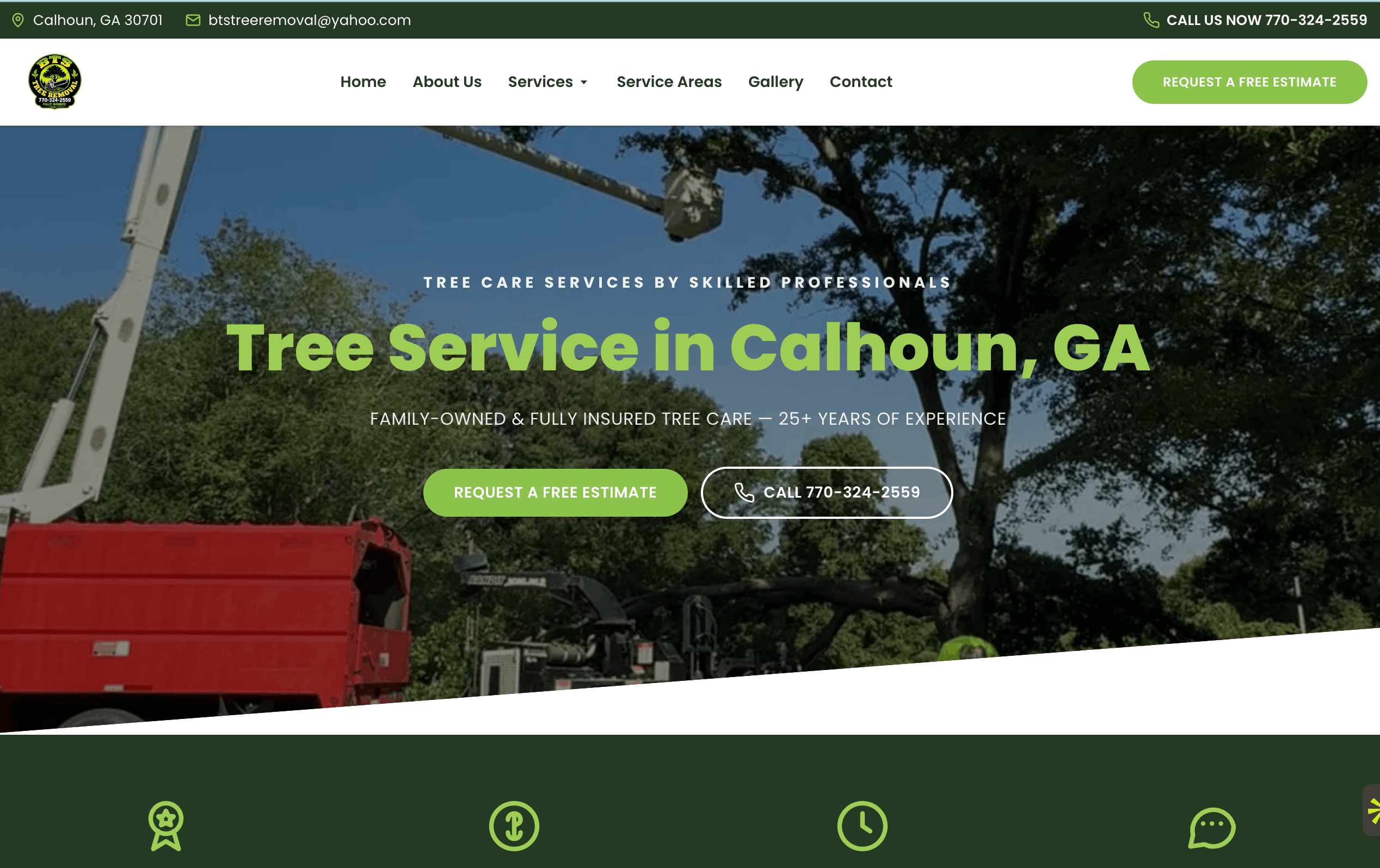
Do Small Businesses Really Need a Website?
I build websites for a living, so you'd expect me to tell you every business needs one. I'm not going to. Some don't — at least not yet.
The honest answer to "do small businesses need a website" depends on two things: where your business is right now, and where you're actually trying to take it. Get those two straight and the answer usually answers itself.
Here in 2026, about 27% of small businesses in the US still don't have a website, according to recent US small-business survey data. That's down from roughly 36% back in 2020, but it's still about one in four. And in the trades — plumbers, landscapers, contractors — it's closer to half. So if you're reading this and you don't have a site yet, you're in plenty of company. The question isn't whether you're behind. It's whether the gap is costing you anything.
The honest answer: it depends on where you are and where you're going
A website is a tool, not a rite of passage. Whether you need one comes down to your stage and your direction.
A side hustle you're testing on weekends has different needs than a five-truck operation trying to book bigger jobs. One of those can probably wait. The other is losing money every week it stays invisible.
So before you spend a dollar, figure out which of these you are.
Where you are right now
Just testing the idea. You're not sure people will even pay for this thing yet. If that's you, don't let anyone — including me — sell you a $5,000 site to validate an idea. Claim a free Google Business Profile, put up a clean one-page site, and see if the phone rings. Spend your money proving demand, not on design.
Established and booked on referrals. Your phone rings, your calendar's full, and you've never spent a cent on marketing. Good for you — that's a real business. But "booked solid" and "safe" aren't the same thing. More on that below, because this is where most owners get quietly burned.
Trying to grow. You want bigger jobs, new customers who've never heard your name, the ability to raise prices, maybe to hire. The second that's your goal, a website stops being optional. You can't get found by strangers if there's nothing to find.
Notice the pattern: the further you want to go, the less optional a website gets. A site you own is the thing that lets a stranger find you, check you out, and decide you're legit — all before they call.
Can't I just rely on word of mouth?
This is the one I hear most, and it's the one that fools the most people. Referrals are great. They're also leakier than you think.
Here's what actually happens. Someone tells their neighbor, "Call this guy, he did our roof." The neighbor doesn't call right away. First they Google your name. That little check — the "are these people real" step — is where you win or lose them. If they land on a real website with photos, reviews, and a phone number, you've basically closed the sale. If they find nothing, or a half-empty Facebook page from 2021, a big chunk of them go look for someone who does show up.
The numbers back this up. Google's own research on how shoppers find local businesses puts it around 81%: that's how many people look a business up online before they buy or call. And when a referred customer Googles a business and finds nothing solid, consumer studies peg it at roughly a 50/50 split — about half still call because the referral was strong, and the other half go find a competitor who looks more established. Businesses without a site lose an estimated 20–35% of their referred customers right at that step.
Run your own math on that. If you get ten good referrals a month and a quarter of them quietly bounce because you're invisible online, that's not a rounding error. That's two or three jobs a month walking to the competitor down the road — and you never even see it happen, because the customer who didn't call doesn't send you a "sorry, couldn't find your website" text.
There's a second problem with leaning on referrals: they don't scale, and they can dry up fast. One big referrer retires or moves, and your pipeline craters overnight. A website doesn't replace word of mouth. It catches the people word of mouth sends you, and it keeps working when the referrals slow down.
What about my Etsy or Yelp page?
A marketplace listing feels like a shortcut. You get traffic, a profile, maybe some sales, and you didn't have to build anything. The catch is you're building on rented land.
When your whole presence lives on Etsy, Yelp, or a marketplace, here's what you don't own:
- The customer relationship. The platform owns it. Etsy knows who bought from you. You often don't.
- The rules. They can change fees, layout, and policies whenever they want, and you find out the same day everyone else does. Marketplace fees have only gone one direction.
- Your visibility. Yelp can bury you under "sponsored" competitors unless you pay. You're renting your own ranking back from them.
- The exit. If you ever get suspended — fairly or by some algorithm mistake — your business can vanish overnight with no appeal that matters.
You're also handing the platform the right to put a competitor's ad directly next to your listing. You did the work to attract that customer's attention, and they get monetized by the people you're competing with.
A website is the one piece of this you actually own. It's your address, your data, your rules. Use the marketplaces for what they're good at — discovery, reach, getting started — but point everything back to a place you control. By the way, a Facebook page isn't a website either, for the exact same reason: you're a tenant there too.
Where you want to go
Back to the part that actually decides this. Forget where you are for a second and ask where you want to be in two years.
If the honest answer is "right here, same size, same handful of repeat clients, and I'm fine with that" — then you might genuinely be okay with just a Google Business Profile and a simple page for now. I'd still get the simple page so your referrals convert, but I'm not going to pretend you need a ten-page site.
If the answer involves any of these, you need a real website you own:
- Getting found by people who've never heard of you
- Charging more and looking the part
- Hiring, and having somewhere to send applicants
- Selling online, taking bookings, or collecting leads while you sleep
- Not depending on a platform or a referrer you don't control
Worth knowing: industry research on small-business marketing has found that businesses running a website and social media together pull in roughly double the revenue of the ones using social media alone. The two aren't an either/or. Social brings people in; the site is where they decide to trust you.
Okay, but what does a website actually cost?
This is the real reason most people stall — they assume "website" means $15,000. It doesn't have to.
- DIY builder (Wix, Squarespace): roughly $0–30 a month, plus your time. Fine for a starter one-pager if you're testing an idea and don't mind doing it yourself.
- A real site built for you: commonly $1,500–$6,000 one-time for a solid local small-business site, depending on how many pages and features you need. This is the lane most established local businesses should be in.
- Ongoing care (hosting, updates, basic SEO): $50–200 a month if you want someone keeping it healthy instead of letting it rot.
- Custom software or e-commerce builds: more than that, because you're paying for an actual application, not a brochure.
The point isn't the exact figure. It's that there's an option at almost every budget, and the "websites are too expensive" excuse usually isn't true anymore. If you're losing two referred jobs a month to invisibility, a $2,000 site can pay for itself in a couple of months.
A simple way to decide
Here's the rule I'd give a friend over coffee:
- Testing an idea? Free Google Business Profile + a one-page site. Don't overspend.
- Established but coasting on referrals? Get at least a basic site so the people word of mouth sends you actually convert. You're leaking customers without it.
- Trying to grow at all? A real website you own, full stop. This is no longer optional.
If you find yourself arguing that your business is "too small" for a website — that's the single most common reason owners give for skipping one, and it's almost always the moment right before growth stalls.
You don't need a website because everyone says so. You need one when the gap between where you are and where you're going runs straight through "people can't find or verify me online." For most businesses that want to grow, that's exactly where the gap is.
Frequently asked questions
Do I really need a website if I'm fully booked on referrals?
You can survive without one, but you're leaking. Most referred customers Google you before they call, and a sizable share won't call if they find nothing. A simple site catches them. It also protects you when a key referrer disappears.
Is a Facebook or Instagram page enough instead of a website?
No. Social media is great for reach and staying in front of people, but you don't own it, you can't control how you show up in search, and the platform can change the rules overnight. Use social to bring people in, and send them to a site you own.
How much does a small business website cost in 2026?
Anywhere from near-zero on a DIY builder to $1,500–$6,000 for a solid site built for you, with optional ongoing care around $50–200 a month. Custom apps and online stores cost more. There's a real option at almost every budget.
Can't I just use my Etsy or Yelp listing?
Those are fine for getting started, but you're building on rented land. You don't own the customer, the fees, or your ranking, and you can be buried or suspended at any time. Keep using them, but anchor your presence to a website you control.
Where you are and where you're headed should decide this — not a sales pitch
If you've hit the point where you want to grow and you'd rather have a website you actually own than rent your presence from a platform, that's the conversation I have with local businesses every week. Tell me where your business is and where you want to take it, and I'll give you a straight answer on what you actually need — even if that answer is "not much yet."
We build custom websites and handle local SEO for small businesses in Chattanooga and across Hamilton County. Most calls end with one or two specific next steps, not a pile of upsells.