We handle the edge cases
The demo always works. The real test is the duplicate record, the partial failure, the field mismatch. We design for those up front so the integration doesn't quietly corrupt data three weeks in.
You bought good tools — a CRM, accounting, e-commerce, scheduling — but they live in separate silos, so data gets re-keyed and reports get assembled by hand. We connect them: API integrations, webhooks, and custom connectors that move data between your systems automatically and keep it in sync.
Based in Chattanooga, serving the Tennessee Valley and remote. Fixed-bid, scoped on a call.
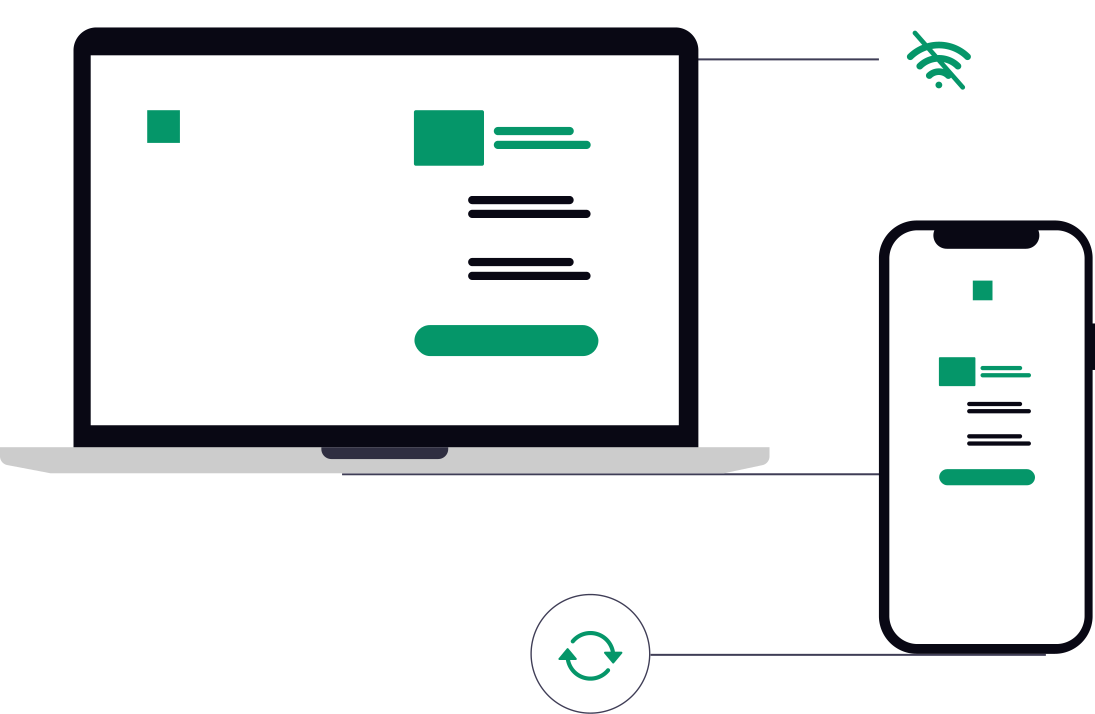
Integration work ranges from a single one-way sync to a hub that keeps several systems consistent in real time. Here's what's typically involved.
Integrations are easy to start and hard to get right — the trouble is always the edge cases: the record that exists in one system and not the other, the field that's required here and optional there, the sync that runs twice. We build for those cases, not just the happy path.
The demo always works. The real test is the duplicate record, the partial failure, the field mismatch. We design for those up front so the integration doesn't quietly corrupt data three weeks in.
Some data needs to sync the instant it changes (a paid invoice, a new order). Some is fine syncing nightly. We pick the right mechanism for each flow instead of over-engineering everything to real time.
Every integration we build has logging, retries, and alerting. When something breaks, you know — you don't find out from a customer.
QuickBooks, Stripe, Shopify, Salesforce, HubSpot, Calendly, Twilio, Google Workspace, and most modern SaaS with an API. If it has an API, we can usually connect it.
Map the data flows, scope, build against real data, monitor. Most integrations are a one-to-four-week project.
We list the systems, what data needs to move where, how fresh it needs to be, and which system is the source of truth for each field.
A diagram of every flow, the direction, the timing, and the conflict rules, with a fixed price.
We build it and test against copies of your real data, including the messy records, before anything writes to production.
We go live with logging and alerting, watch the first syncs closely, and document the whole thing.
When your systems stay in sync on their own, an entire category of manual work and reconciliation disappears.
Data entered once shows up everywhere it's needed. Nobody types the same customer into three systems.
When the systems stay in sync, your reports agree with each other and with reality.
A sale, a payment, or a booking is reflected everywhere instantly — so decisions are based on current data.
Software integration lets your existing tools keep working together instead of forcing a rip-and-replace onto one all-in-one platform.
A single one-way sync between two tools often runs $2,500–$5,000. Two-way sync, multiple systems, or a hub with conflict handling runs $6,000–$20,000. We quote fixed-bid after mapping the data flows.
We’re based in Chattanooga and work with small businesses across the region — Hixson, East Ridge, Red Bank, Soddy-Daisy, Signal Mountain, Ooltewah, Collegedale, Cleveland TN, and Dalton GA — plus remote clients anywhere.
See the cities we serveConnecting the tools you already use so your team stops copy-pasting between them.
Learn moreInternal tools, dashboards, and focused web apps built around how your business actually works.
Learn morePostgreSQL schemas, query optimization, and indexing strategy — the work that makes slow apps fast and tangled data clean.
Learn moreFree 30-minute call. Tell us which tools should be talking and aren't, and we'll tell you what it takes to connect them.